“I Don’t Care”: What May Be Hiding Beneath a Teenager’s Apathy
“My daughter’s teachers say that she’s fine at school, but I see a completely different version of her at home. She has meltdowns, has no energy and battles with me about homework and studying. She has no filter—she says exactly what she feels, and sometimes that’s pretty ugly.”
A parent shared this with me during an initial coaching meeting a few months ago. It is an experience many families will recognise.
At school, their teenager appears happy, polite and motivated. Teachers report that everything is fine. But as soon as they walk through the front door, something changes. They may become irritable, withdrawn, argumentative or completely exhausted. Homework feels impossible. Even a small request can lead to conflict or a meltdown.
This is sometimes described as after-school restraint collapse: a young person holds themselves together throughout the school day and then releases everything once they reach the safety of home.
“I don’t really care”
When I first met this young person, I didn’t see the version her teachers described. She showed me more of the self she usually reserved for her family.
She couldn’t see the point of executive function coaching. She told me that everything was fine because she didn’t really care how she was doing at school.
In fact, “I don’t really care” was a phrase she repeated often.
Perhaps you hear something similar at home:
“I don’t care about the test.”
“I don’t care if I’m behind.”
“I don’t care what my teachers think.”
It is easy to interpret those words as laziness, defiance or a lack of motivation. But what might be happening beneath the surface?
When “I don’t care” really means “I can’t hold any more”
In this teenager’s case, we gradually came to understand that the apathy and meltdowns were connected to the amount of effort it took to get through each school day.
She wasn’t really “fine,” as her teachers believed. She was playing a role—and playing that role was exhausting.
She was highly sensitive to both the emotional atmosphere around her and the sensory demands of school. Changes in someone’s tone of voice, loud conversations, bright lights and the collective anxiety before a test could all have an impact. She noticed every shift in mood, sometimes before anyone had put it into words.
Pretending not to care became a form of protection.
If she didn’t care about falling behind, she didn’t have to feel the fear of not catching up. If she didn’t care about her grades, she could temporarily escape the pressure surrounding them. If she appeared indifferent, she did not have to explain how overwhelmed she felt.
But it wasn’t that she didn’t care.
She simply didn’t have the capacity to hold it all.
Sharpened Senses
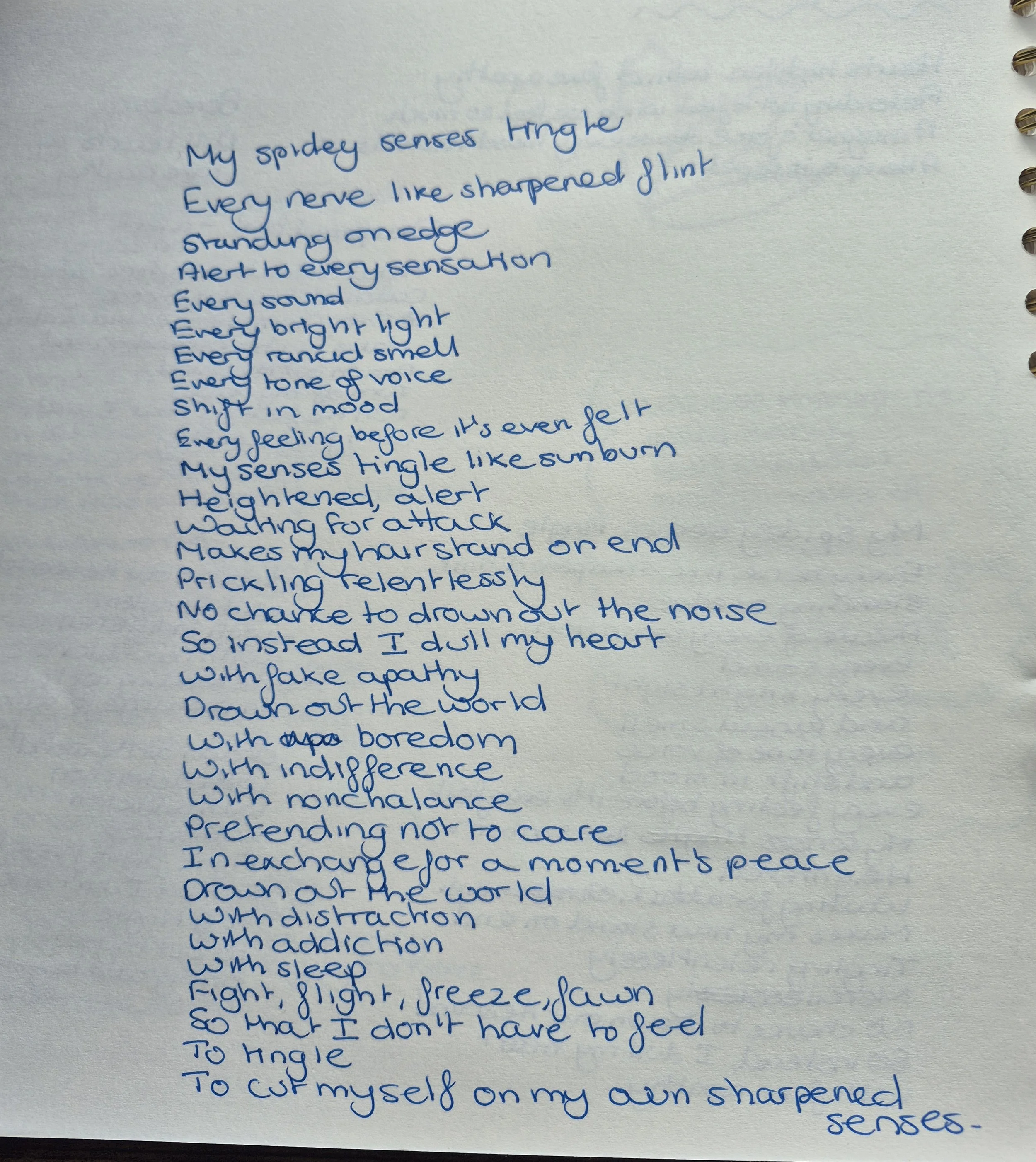
My original handwritten poem, created while reflecting on the hidden sensory and emotional demands experienced by some young people.
I wrote this poem while reflecting on what her experience of the world might feel like. These are my words and my interpretation, rather than the young person’s own account.
My spidey senses tingle,
Every nerve like sharpened flint,
Standing on edge,
Alert to every sensation.
Every sound,
Every bright light,
Every rancid smell,
Every tone of voice,
Shift in mood,
Every feeling before it’s even felt.
My senses tingle like sunburn:
Heightened, alert,
Waiting for attack.
It makes my hair stand on end,
Prickling relentlessly.
No chance to drown out the noise,
So instead I dull my heart
With fake apathy,
Draw out the world
With boredom,
With indifference,
With nonchalance,
Pretending not to care,
In exchange for a moment’s peace.
Drown out the world
With distraction,
With addiction,
With sleep.
Fight, flight, freeze, fawn,
So that I don’t have to feel,
To tingle,
To cut myself on my own sharpened senses.
Why organisation strategies may not be the starting point
Highly sensitive, anxious and neurodivergent teenagers may experience school very differently from the adults around them. Some use masking to hide distress, meet expectations or avoid drawing attention to themselves.
By the time they get home, they may have used most of their available energy. The difficult behaviour parents see is not necessarily evidence that home is causing the problem. Sometimes it is evidence that home is the place where the young person finally feels safe enough to stop holding everything in.
This young person was right about one thing: she didn’t need me to begin by teaching her how to be more organised or motivated.
Before we could work effectively on planning, homework or study habits, she needed help to understand her overwhelm, find ways to regulate and experience genuine rest.
In our coaching sessions—and in conversations with her parents—we focused on three things.
1. Reducing unnecessary demands
When someone is overwhelmed, adding more goals, strategies and expectations can increase the pressure. We identified what was genuinely essential and what could be reduced, postponed or temporarily removed.
The aim was not to avoid every challenge. It was to create enough breathing space for recovery.
2. Returning to basic needs
We looked at sleep, nutrition, movement, sensory recovery and time without social or academic demands.
These things are not a magical cure for burnout, and they are not always easy to address. However, when basic needs have been pushed aside, gently rebuilding them can provide a foundation for everything else.
3. Managing “energy coins”
We used the idea of energy coins to make an invisible experience more concrete.
All of us have a finite amount of time and energy. When a teenager is overwhelmed, it can help to ask:
What do I need to spend my energy coins on today?
What am I spending energy on without realising it?
What do I not have capacity for right now?
What helps me recover or gives me more energy coins?
Where can an adult reduce the energy cost of a task?
This helped us move away from judging what she “should” be able to do and towards understanding what different tasks actually cost her.
Sometimes teenagers need less before they can do more
Executive function coaching is often associated with planners, routines, motivation and study strategies. Those tools can be useful—but they are not always the place to begin.
A young person who is overwhelmed, burned out or chronically fatigued does not necessarily need more strategies. They may first need fewer demands, more understanding and permission to recover.
Once there is a little more capacity, the next stage of the work can begin: understanding patterns, communicating needs, developing self-advocacy and gradually finding sustainable ways to manage school and everyday life.
If your teenager seems fine at school but regularly melts down, shuts down or says “I don’t care” at home, it may be worth looking beneath the behaviour.
The better question may not be, “How can I make them try harder?”
It may be:
“What is taking so much energy—and what would help them feel safe enough to stop pretending they don’t care?”
Names and identifying details have been changed to protect confidentiality.
If your teenager appears fine at school but regularly melts down or shuts down at home, masking or after-school restraint collapse may be part of the picture.
If this experience feels familiar, you can learn more about my executive function coaching for teenagers or email me to book an initial conversation to explore whether coaching could support your teenager and your family.
